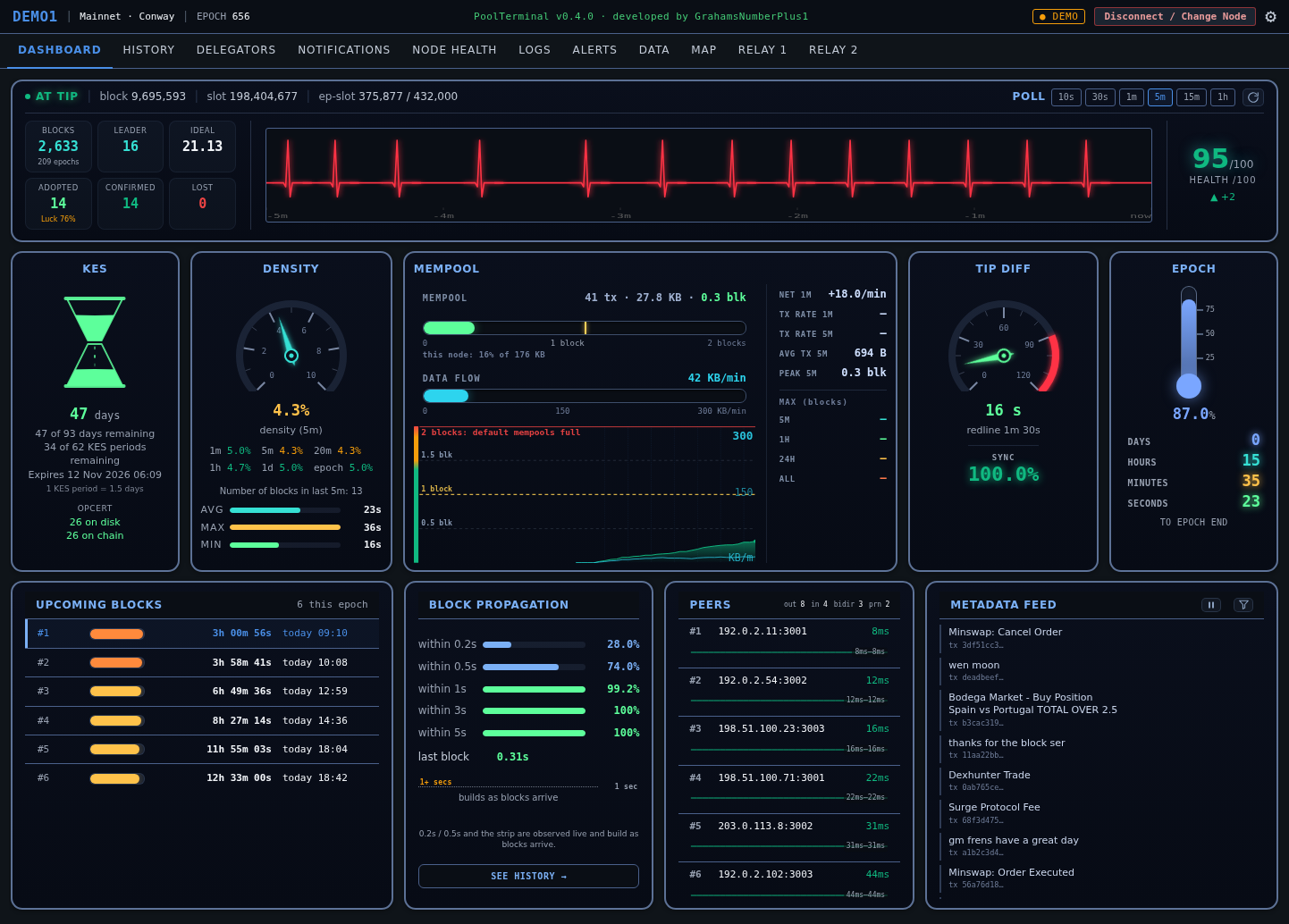
Each tab is a focused, live operational view. Everything repaints instantly from cache when you return to it, refreshing live behind.
DASHBOARD
Live epoch dashboard
Chain pulse, tip/sync, KES expiry as an hourglass whose sand drains as the key ages, the on-disk vs on-chain op-cert counter, a mempool panel that counts the queue in blocks against the 2-block line where default-size mempools fill up, with real KB/min flow, sub-second block propagation, upcoming leader slots with countdowns, and a live CIP-20 metadata feed.
HISTORY
Every epoch, back to the start
Blocks, ideal, luck, delegators, active stake, and a six-way reward split - including your own SPO earnings per epoch. Charts for blocks and luck over time.
DELEGATORS
Loyalty, stake & journeys
Every delegator in one sortable table with a computed loyalty ranking. Deep-dive any delegator: balance, rewards, a stake-history graph, and a pool-movement journey showing every pool they've ever delegated to. Figures are reconciled against live account state, so a number that reads under an explorer is explained rather than left looking like a bug.
NOTIFICATIONS
Delegation activity, live
Delegators joining, leaving, returning or moving stake - detected on-chain within minutes, colour-coded with from→to flows, amounts, and one-click transaction links. Epoch-boundary reward bumps are netted out precisely on db-sync, so only genuine activity surfaces.
NODE HEALTH
Host & process metrics
CPU, memory, peers and node-process resources with historical samples, so you can see how your machine trends over time.
LOGS
Diagnostics without a shell
A read-only workspace over your node's journal and CNCLI data - every query bounded and run at low priority so it never competes with block production. Errors, restarts, rollbacks and KES status in one click; your full minted-block history; and a propagation record that keeps the slowest blocks long after they scroll off the dashboard, with an epoch-transition view that tells a real chain gap apart from PoolTerminal simply being closed.
ALERTS
Telegram, with no agent on your BP
Every other SPO alerting setup wants an agent, a cron job or a monitoring stack beside your node. PoolTerminal already receives this data every poll, so it just sends it on. Six alerts - KES expiry, node stall, block minted, slow propagation, mempool full (2+ blocks queued), low peers - each with its own threshold, a Test button, a global cooldown and optional quiet hours.
DATA
Where every number comes from
A transparency screen showing exactly which source is answering each feature - your node, db-sync, Koios or Blockfrost - and what each optional source would unlock if you added it.
MAP
Your node & its peers
A full-size world map plotting your node and live peers, geo-located, with latency-coloured connections and geographic distribution. Cached offline after first load.
RELAY 1 / 2
Isolated relay dashboards
Each relay monitored independently, straight from its own cardano-node over its own connection - a stalling relay flatlines only its own heartbeat, never affecting the others.
SETUP WIZARD
Guided first-run
A step-by-step walkthrough: connect to your node, optionally add db-sync and Blockfrost. The db-sync path is a guided decision tree that can even generate and authorise an SSH key for you.
DEMO MODE
Try it with no node
Built-in synthetic pool data so you can explore the full interface before connecting anything real - the same data driving the live terminal at the top of this page.